 Jane Doe, M.A.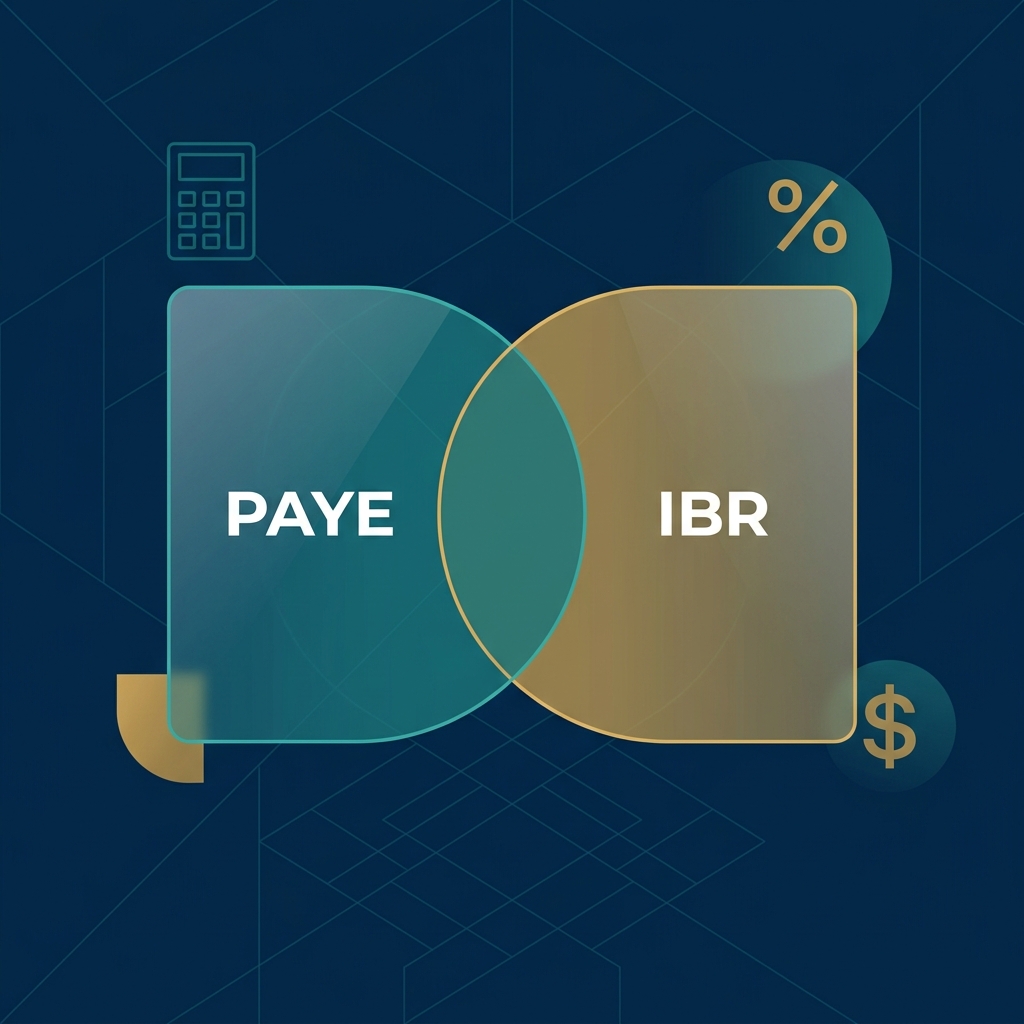
PAYE vs. IBR: Which 10% Repayment Plan is Actually Better for Your Budget?
You pulled up your loan servicer portal. You clicked "change repayment plan." And there they were—two options sitting right next to each other, both promising 10% of discretionary income, both offering 20 years to forgiveness.
Pay As You Earn (PAYE) and Income-Based Repayment (IBR) for new borrowers.
Same percentage. Same forgiveness timeline. So what is the actual difference?
If you are a physician finishing residency, a newly barred attorney staring at $190,000 in law school debt, or any professional whose income is about to rise dramatically over the next decade, the answer to that question is worth tens of thousands of dollars. Because while these two plans look like identical twins on paper, they behave very differently once your salary starts climbing.
The Surface-Level Similarities
Let's get the overlap out of the way first. If you are a "new borrower"—meaning you had no outstanding federal loan balance before July 1, 2014, or you first borrowed on or after that date—both PAYE and IBR offer the following:
- Payment: 10% of discretionary income
- Discretionary income definition: AGI minus 150% of the federal poverty guideline
- Forgiveness: After 20 years of qualifying payments
- PSLF eligibility: Both plans qualify for Public Service Loan Forgiveness after 120 payments
If you are unfamiliar with how that 10% calculation actually works, we walk through it step-by-step in our guide on how to calculate your IBR payment. The formula is identical for both plans.
So far, they are twins. But now let's talk about where the DNA diverges.
The Payment Cap: Where Everything Changes
This is the single most important difference, and it is the reason you are reading this article instead of just flipping a coin.
PAYE: Your Payment Has a Permanent Ceiling
Under PAYE, your monthly payment is permanently capped at the 10-year Standard Repayment amount calculated when you first entered the plan. If your income doubles, triples, or quadruples over the next decade, it does not matter. Your payment hits that ceiling and stays there.
IBR: The Cap Works the Same Way—But There is a Catch
IBR also caps your payment at the 10-year Standard amount. On the surface, identical behavior. But here is where many borrowers get tripped up: under the old IBR rules, if your income rose enough that you no longer demonstrated a "partial financial hardship," you could lose the income-driven calculation entirely and get stuck at the Standard payment.
The good news? Recent legislation has removed the partial financial hardship requirement for IBR enrollment. You can now stay on IBR regardless of income growth, and the payment cap remains in effect.
So in practice, the cap mechanics are now functionally similar between the two plans. But the eligibility gates to get into each plan are still very different.
Eligibility: The Real Fork in the Road
This is where most "PAYE vs. IBR" articles fall apart, because they forget to mention the requirements that actually disqualify people.
| Requirement | PAYE | IBR (New Borrower) |
|---|---|---|
| "New Borrower" Cutoff | No balance before Oct 1, 2007 and received a Direct Loan disbursement on/after Oct 1, 2011 | No outstanding balance on Direct or FFEL loans before July 1, 2014 |
| Eligible Loan Types | Direct Loans only | Direct Loans and FFEL Program Loans |
| Partial Financial Hardship | Required — must prove your calculated payment is lower than Standard | No longer required — removed by recent legislation |
| Parent PLUS Loans | Not eligible | Not eligible |
| New Enrollment After July 1, 2026 | Closed to first-time borrowers | Open |
| Full Phase-Out | July 1, 2028 — all borrowers must switch | No phase-out planned |
Read that last row carefully. PAYE is dying. As of July 1, 2026, new borrowers who have never held federal loans can no longer enroll. By July 1, 2028, everyone on PAYE must transition to another plan. If you are choosing between these two plans right now in mid-2026, this sunset date alone should heavily influence your decision.
The High-Income Professional Scenario
Let's run the actual math for the audience that cares most about this comparison: someone whose income is going to grow aggressively.
Meet David. He is a 30-year-old attorney who just finished law school. He owes $195,000 in federal Direct Loans at 7.0% average interest. His starting salary at a mid-size firm is $95,000. He is single, no dependents.
In 2026, the 150% poverty guideline for a household of 1 is $22,590.
Year 1 Payment Calculation:
Discretionary Income: $95,000 − $22,590 = $72,410
10% Annual Payment: $72,410 × 10% = $7,241
Monthly Payment: $7,241 ÷ 12 = $603.42
David's 10-year Standard Repayment amount on $195,000 at 7.0% is approximately $2,264/month. Since $603 is well below $2,264, both PAYE and IBR produce the same payment in Year 1. No drama.
But David is on partner track. Let's fast-forward.
| Year | Salary | Calculated 10% Payment | Standard Cap | Actual Monthly Bill (Both Plans) |
|---|---|---|---|---|
| 1 | $95,000 | $603 | $2,264 | $603 |
| 3 | $120,000 | $812 | $2,264 | $812 |
| 5 | $155,000 | $1,103 | $2,264 | $1,103 |
| 8 | $210,000 | $1,562 | $2,264 | $1,562 |
| 12 | $290,000 | $2,228 | $2,264 | $2,228 |
| 15 | $350,000 | $2,728 | $2,264 | $2,264 (capped) |
By Year 15, David's income has risen so high that his calculated 10% payment exceeds the Standard Repayment cap. Under both PAYE and IBR, his payment freezes at $2,264. The cap protects him from that $2,728 figure.
(Note: This cap is the only thing keeping David from a $2,700+ monthly nightmare. If he had refinanced with Earnest or SoFi three years ago to "lock in a lower rate," he would have zero cap, zero forgiveness runway, and zero federal protections. This is why we don't private refinance.)
Here is the key insight most people miss: for someone like David, the plans behave identically in practice. The real difference is not in the monthly payment—it is in plan stability and future-proofing.
PAYE Is Being Phased Out. That Changes the Calculus.
Let's be direct. If you are a new borrower choosing a plan today, there is almost no strategic reason to pick PAYE over IBR.
The Department of Education is eliminating PAYE by July 2028. If David enrolled in PAYE today, he would be forced to switch plans within two years. That means reapplying, potentially dealing with servicer processing delays, and navigating whatever transition rules the Department rolls out. If he is pursuing Public Service Loan Forgiveness, a botched plan transition could jeopardize his qualifying payment count.
IBR has no sunset date. It is the plan the government is keeping. Period.
When PAYE Used to Win (And Why It No Longer Matters)
Historically, PAYE had two clear advantages over IBR:
-
PAYE never required you to lose the hardship test. Your payment was always income-driven, even if your income skyrocketed. IBR used to boot you back to the Standard payment if you could no longer demonstrate partial financial hardship.
-
PAYE had a more generous "new borrower" date. The October 2007/October 2011 cutoff captured borrowers that the July 2014 IBR cutoff excluded.
Both of these advantages have evaporated. The hardship requirement for IBR has been legislatively removed. And the PAYE eligibility window is now closing, while IBR remains open.
If you borrowed between October 2011 and July 2014, you were once in a sweet spot where PAYE was your only 10% option. That window still technically exists—but only until July 2028. After that, those borrowers will need to find a new plan regardless.
The FFEL Loan Gotcha
Here is a scenario that still trips people up.
If you hold legacy FFEL Program loans—common for borrowers who attended school in the mid-2000s—PAYE is not an option. PAYE only accepts Direct Loans. You would need to consolidate your FFEL loans into a Direct Consolidation Loan first, and even then, you must still meet the PAYE "new borrower" definition.
IBR, on the other hand, accepts FFEL loans directly. No consolidation required. We covered the nuance of how your loan origination date impacts your IBR terms in our deep dive on whether you qualify as a "new borrower".
If you hold mixed loan types (some Direct, some FFEL), IBR is the path of least resistance.
The Married Borrower Twist
Both PAYE and IBR use the same AGI-based formula, which means your filing status matters enormously. If you are married and your spouse earns significantly more than you, filing Married Filing Separately (MFS) can slash your calculated payment under either plan.
The catch? MFS comes with brutal tax penalties—you lose the student loan interest deduction, education credits, and potentially the Earned Income Tax Credit. We did the full breakeven math in our Married Filing Separately IBR strategy guide. If you are married and carrying heavy student debt, read that before touching your tax return.
The one detail worth noting here: both PAYE and IBR treat MFS identically. There is no advantage to one plan over the other when it comes to spousal income exclusion. Your choice of plan does not change the tax strategy.
So Which Plan Should You Actually Pick?
Let me make this painfully simple.
Choose IBR if:
- You are a new borrower (first loan on/after July 1, 2014)
- You want long-term plan stability with no phase-out risk
- You hold any FFEL loans
- You want to avoid the partial financial hardship requirement entirely
- You are pursuing PSLF and cannot afford a plan transition disrupting your qualifying payments
Choose PAYE only if:
- You are already enrolled and your forgiveness timeline is far enough along that switching plans would reset progress (unlikely for most borrowers, but verify with your servicer)
- You borrowed between October 2011 and July 2014 and do not qualify as an IBR "new borrower"—though remember, the 15% IBR rate with 25-year forgiveness is still available as a fallback
For the vast majority of borrowers reading this in 2026, IBR is the correct answer. PAYE is a plan living on borrowed time.
Don't Let a Private Lender Distract You
One more thing. If your salary is climbing rapidly—like David's in the example above—you will inevitably start seeing ads from private lenders promising lower interest rates. We have already dissected Earnest's student loan refinance pitch versus federal IBR, and the conclusion is the same: unless you have zero interest in PSLF, have a massive emergency fund, and your calculated IDR payment already exceeds your Standard payment, refinancing away your federal protections is a gamble you probably shouldn't take.
The payment cap on IBR exists specifically to protect high earners like David from paying more than the Standard amount. There is no need to refinance to "escape" high IDR payments—the cap already does that for you.
Run Your Numbers. Both Plans. Right Now.
You've read the comparison. You understand the cap logic, the eligibility differences, and the phase-out timeline. Now you need your actual number.
Don't rely on your servicer's website to show you the right answer—half the time their estimators are wrong, and they have zero incentive to steer you toward the plan that costs you less.
Open our free income based repayment plan calculator and plug in your AGI, your family size, and your loan balance. It runs the exact Department of Education formula and shows you your monthly payment, your total interest cost over the life of the plan, and exactly what month you hit forgiveness.
If the number under IBR at 10% gives you breathing room, lock it in. If it doesn't, at least you know exactly what you're working with before you make a decision you can't undo.
Disclaimer: This article is for educational purposes only and does not constitute financial or legal advice. Student loan rules change frequently — always verify current information at StudentAid.gov.