 Jane Doe, M.A.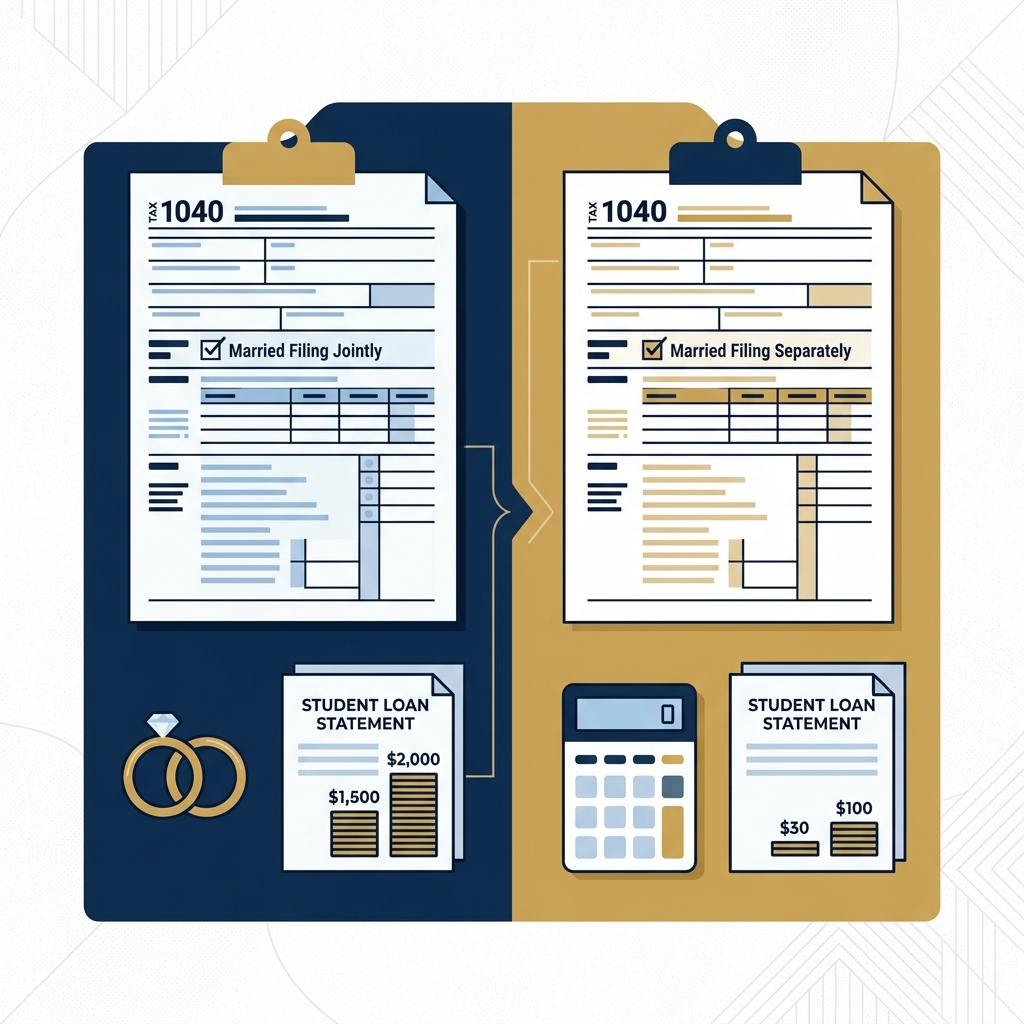
Should You File Taxes Separately to Lower Your IBR Payments? (The 2026 Strategy Guide)
Every married borrower on an Income-Based Repayment plan eventually lands on this question. Usually at 11:30pm on a Tuesday, hunched over TurboTax, wondering if checking a different box could save them real money.
The logic sounds bulletproof: if you file Married Filing Separately (MFS), your spouse's income disappears from your Adjusted Gross Income. Your AGI drops. Your income based student loan repayment percentage is applied against a smaller number. Your monthly payment shrinks—sometimes dramatically.
But there is a reason your accountant winces every time you bring this up.
Filing separately doesn't just change your student loan math. It rewrites your entire tax situation. And more often than not, the tax penalties of MFS are larger than the student loan savings you thought you were getting.
Saving $200 on student loans but losing a $2,000 tax credit is a bad deal. Full stop.
Let's break down the actual numbers so you can see exactly where the tipping point is.
How Filing Status Changes Your IBR Payment
If you are unfamiliar with the core formula, we covered it step-by-step in our guide on how to calculate your IBR payment. The short version: the Department of Education takes your Adjusted Gross Income, subtracts 150% of the federal poverty guideline for your family size, and applies a flat percentage—either 10% or 15%—to whatever remains. That's your annual payment obligation, divided by 12.
The critical variable for married couples is which AGI the government uses.
- Married Filing Jointly (MFJ): Your servicer uses your combined household AGI. Both incomes count.
- Married Filing Separately (MFS): Your servicer uses only your individual AGI. Your spouse's salary is invisible.
For couples where one partner earns significantly more than the other, this distinction can swing your monthly bill by hundreds of dollars.
The Real-World Math: A Couple With Unequal Incomes
Meet Marcus and Priya. Marcus is a high-school history teacher earning $48,245. Priya is a software engineer pulling in $114,890. Marcus owes $72,000 in federal student loans (new borrower, 10% rate). Priya has no student debt.
They are a family of two. In 2026, 150% of the poverty line for a household of two is $30,660.
Let's run both scenarios.
Scenario A: Married Filing Jointly
Combined AGI: $48,245 + $114,890 = $163,135
Discretionary Income: $163,135 − $30,660 = $132,475
Annual IBR Payment: $132,475 × 10% = $13,247.50
Monthly IBR Payment: $13,247.50 ÷ 12 = $1,103.96
That is a brutal number. Marcus's IBR payment is actually higher than his standard 10-year repayment amount (roughly $830 on $72k at 6.5%). When that happens, the IBR system caps him at the standard payment, but the point stands: filing jointly makes IBR nearly useless because Priya's income inflates his AGI massively.
Scenario B: Married Filing Separately
Marcus's Individual AGI: $48,245
Discretionary Income: $48,245 − $30,660 = $17,585
Annual IBR Payment: $17,585 × 10% = $1,758.50
Monthly IBR Payment: $1,758.50 ÷ 12 = $146.54
That is a jaw-dropping difference. By filing separately, Marcus's monthly payment drops from $830 (the capped standard amount) down to $146.54. He saves $683.46 every single month on his student loans.
But hold on. Don't file your return yet.
What Filing Separately Costs You in Taxes
Here is the part that most student loan blogs conveniently skip over. The IRS does not offer MFS filers the same tax breaks as MFJ filers. And the penalties stack up fast.
| Tax Benefit | Married Filing Jointly | Married Filing Separately | Annual Cost of MFS |
|---|---|---|---|
| Student Loan Interest Deduction | Up to $2,500 deduction | $0 — Completely eliminated | ~$550 in lost tax savings |
| Child & Dependent Care Credit | Up to $2,100 credit | $0 — Completely eliminated | Up to $2,100 |
| Earned Income Tax Credit (EITC) | Potentially available (income limits apply) | $0 — Completely eliminated | Up to $7,830 |
| Education Credits (LLC, AOTC) | Up to $2,500 (AOTC) or $2,000 (LLC) | $0 — Completely eliminated | Up to $2,500 |
| Roth IRA Contributions | Phase-out at $230,000+ | Phase-out starts at $10,000 | Lost retirement flexibility |
| Standard Deduction | $30,000 | $15,000 each | $0 (neutral) |
Look at that list. If Marcus and Priya have a child in daycare, they just lost a $2,100 childcare credit by filing separately. If either of them is still taking graduate classes, there go the education credits. And that student loan interest deduction? Completely gone under MFS. The irony is almost cruel: you file separately to reduce your student loan costs, and the IRS punishes you by eliminating the only deduction designed to help with student loans.
The Breakeven Analysis: When MFS Actually Wins
So does filing separately ever make sense? Absolutely. But only when the math is overwhelmingly in your favor.
Let's return to Marcus and Priya. They don't have kids, neither is taking classes, and they don't claim the EITC (their combined income is way too high). The realistic tax penalties they face are:
- Lost student loan interest deduction: ~$550/year
- Compressed tax brackets under MFS: ~$1,800/year in additional taxes
- Roth IRA ineligibility for Priya: significant, but a Backdoor Roth conversion still works
Total realistic annual tax penalty: roughly $2,350.
Now let's stack that against Marcus's student loan savings.
| Filing Strategy | Monthly IBR Payment | Annual Loan Cost | Annual Tax Penalty | Net Annual Savings |
|---|---|---|---|---|
| MFJ (Baseline) | $830 (capped at standard) | $9,960 | $0 | — |
| MFS (Strategy) | $146.54 | $1,759 | −$2,350 | +$5,851 |
Marcus saves $8,201 per year on loan payments and loses $2,350 in tax benefits. His net gain is $5,851 per year. For this couple, filing separately is a slam dunk.
Quick aside: If Priya earns $114,890, she's in a different tax bracket entirely when filing separately. MFS might actually push her individual marginal rate HIGHER than it would be under MFJ. Don't step over a dollar to pick up a dime—always run both sides of the household's 1040 before you commit.
But change one variable—add a toddler in daycare—and that $2,100 childcare credit loss closes the gap significantly. Add an Earned Income Tax Credit scenario (for lower-income families), and MFS can quickly become a net loss.
The Income Ratio Rule of Thumb
After running these scenarios dozens of times for different borrowers, here is the rough heuristic:
Filing separately tends to pay off when:
- The income gap between spouses is wide (at least 2:1 ratio)
- The borrower-spouse is the lower earner
- The household does not claim child-dependent tax credits
- Student loan balances are large (higher balances mean IBR generates real savings)
- You're pursuing PSLF (because every dollar saved accelerates tax-free forgiveness)
Filing separately usually backfires when:
- Both spouses earn roughly the same income
- You rely on childcare credits, EITC, or education credits
- Your student loan balance is small (the IBR savings are tiny, but the tax hit is fixed)
- You're aggressively paying down your balance rather than pursuing forgiveness
If you are chasing PSLF, the calculus changes dramatically. Every dollar you shave off your monthly IBR payment is another dollar forgiven tax-free after 120 qualifying payments. In that scenario, even modest loan savings from MFS are amplified because you aren't just saving money month-to-month—you are inflating the total forgiveness amount at the 10-year mark.
The SAVE Plan Wrinkle (And Why It Doesn't Matter Right Now)
You may have heard that the SAVE plan uses combined spousal income regardless of filing status. That would have killed this entire MFS strategy.
It doesn't matter right now. The SAVE plan is currently frozen in legal limbo and is not accepting new enrollees. If you are on IBR—which is where most married borrowers have landed in 2026—your filing status still directly controls your AGI for payment calculation purposes.
If the courts eventually revive SAVE with the spousal income provision intact, this entire strategy could become irrelevant for future SAVE enrollees. But for classic IBR borrowers today? Your tax return is still your most powerful lever.
The PSLF + MFS Power Play
This is where the strategy gets genuinely exciting. Let's revisit Marcus. He is a public school teacher. That means he works for a qualifying employer for Public Service Loan Forgiveness.
If Marcus files jointly, his capped IBR payment is $830/month. Over 120 PSLF payments, he pays $99,600 before forgiveness.
If Marcus files separately, his IBR payment is $146.54/month. Over 120 PSLF payments, he pays $17,585 before forgiveness.
The difference? Marcus pays $82,015 less over the life of his PSLF timeline. Even after accounting for 10 years of MFS tax penalties (roughly $23,500 total), Marcus comes out ahead by nearly $58,500.
That is not a rounding error. That is a down payment on a house. Don't just buy a more expensive SUV with that savings—use that cleared-up DTI to finally get approved for a mortgage. (Seriously, if you haven't looked at how IBR payments affect your mortgage approval, you are leaving money on the table.)
What If You Aren't Sure Whether MFS Is Worth It?
Here is the honest truth: no article can give you a definitive answer without seeing your actual tax return, your actual loan balance, and your actual family situation. The variables are just too personal.
What you can do right now is establish your baseline.
Your first step is knowing your exact IBR payment under both filing scenarios. If you don't know what your income based student loan repayment percentage produces at your individual AGI versus your combined AGI, you are flying blind. You have to anchor the math before you ever loop in a tax professional.
Don't hand your CPA a vague question like "should we file separately?" Hand them two concrete numbers: "My IBR payment is $830 filing jointly and $147 filing separately. Is the $683 monthly savings worth the tax hit for our specific situation?"
That kind of precision makes the conversation productive instead of theoretical.
Skip the Guessing
Whether you are running the new borrower 10% calculation or the older 15% rate, the formula is the same—only the inputs change based on your filing status. Grab your spouse's W-2 from the top drawer and your own 1040 before you click below—it makes the 30-second calculation actually accurate.
If you want to compare your MFJ and MFS scenarios side-by-side, run both versions through our free IBR Calculator right now. Plug in your individual AGI for the MFS scenario, then plug in your combined household AGI for the MFJ scenario. Write down both monthly payments. Then sit down with your tax preparer and run the full comparison.
This is the most important financial decision married IBR borrowers make every single year. Don't let a hunch—or a Reddit thread—make it for you.
Disclaimer: This article is for educational purposes only and does not constitute financial or legal advice. Student loan rules change frequently — always verify current information at StudentAid.gov.